

A recumbent bike gives you a seated riding position, back support, and a compact way to add cycling to your home routine. Our guide to best recumbent bike options compares 3 models from TRMDDF, USLIM, Birdfeel, with differences in resistance, seat adjustment, and console features.
Use the comparison below to narrow your choices by how you plan to ride and who will use the bike. For more equipment ideas, browse our exercise bikes category.

Pros
- 16 magnetic resistance levels
- 400 lb weight capacity
- Quiet operation
- LCD with five workout metrics
- Transport wheels included
Cons
- No backrest adjustment details provided
- Compact display may limit readability
- Assembly still required

Pros
- 400 lb maximum capacity
- Eight magnetic resistance levels
- Adjustable padded seat and backrest
- Arm and leg movement
- Built-in transport wheels
Cons
- 53.1 lb unit weight
- Large 55.1-inch length
- No workout programs listed
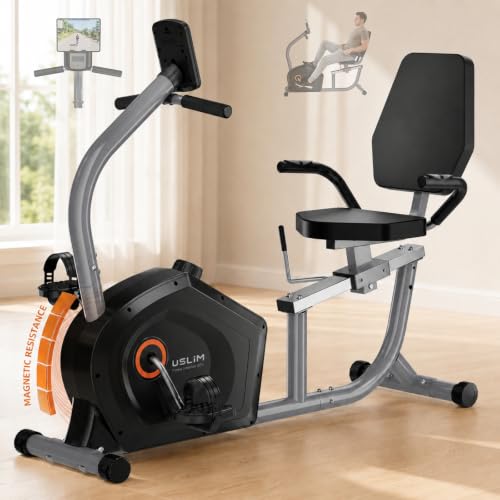
Pros
- 16 magnetic resistance levels
- 400 lb weight capacity
- Quick-adjust seat for varied heights
- LCD with pulse sensors
- Front transport wheels
Cons
- Large 45 x 22-inch footprint
- 51 lb frame may be cumbersome to lift
- No review details available
Resistance Range and Adjustability
Resistance determines how much you can vary your pedaling effort, so consider both the number of settings and how easily you can change them. The TRMDDF and USLIM models offer 16 magnetic resistance levels, while the Birdfeel model has eight.
More levels can make it easier to fine-tune a ride, but a simple dial may be preferable if you value straightforward controls. Think about whether multiple household members need noticeably different settings before prioritizing a wider range.
Seat Fit and Riding Comfort
A recumbent bike should let you reach the pedals without stretching your legs fully or crowding your knees. Look for a sliding seat, a supportive backrest, and an adjustment method you can manage without repeatedly reaching for tools.
The USLIM seat adjusts for riders listed from 4 feet 9 inches to 6 feet 2 inches, while the Birdfeel model includes an adjustment handle and adjustable footrests. Compare those details with the intended riders’ heights and preferred seated position.
Frame Stability and Weight Capacity
Check the stated capacity and frame construction, especially when the bike will see frequent use or serve several riders. All three options list a 400-pound capacity, and each uses a steel frame for a stable riding platform.
Capacity alone does not tell the whole story, so consider leveling feet, floor space, and whether the bike wobbles during a seated pedal stroke. If possible, measure the intended location and leave room to mount, dismount, and move the seat.
Console and Tracking Information
Displays vary in the workout information they provide, so decide which readings you will actually use. The TRMDDF monitor lists time, speed, distance, calories, and heart rate, while the USLIM display adds an odometer and includes pulse sensors.
The Birdfeel dual LCD monitor shows speed, time, distance, and calories. If you like following a show or reading while riding, the USLIM phone and tablet holder is a practical extra to consider.
Noise and Resistance Mechanism
Magnetic resistance is a common choice for indoor bikes because it adjusts without the friction-based contact used by some mechanisms. Noise claims differ across these listings: USLIM specifies operation below 10 dB, and Birdfeel lists under 20 dB.
Those figures are manufacturer-provided details, not a direct comparison under identical conditions. For shared living spaces, also consider where the bike will sit, the floor surface, and whether nearby rooms need to stay quiet.
Assembly, Storage, and Useful Extras
Assembly estimates and included parts can affect how quickly a bike fits into your routine. TRMDDF and USLIM describe their bikes as 90% pre-assembled, while Birdfeel lists 80% pre-installed components; all include transport wheels for moving the equipment.
For small rooms, check the product dimensions and the clearance needed around the pedals before ordering. If you are weighing different kinds of indoor cardio equipment, our walking pad with incline guide and incline treadmill comparison cover other home setups.
Why You Should Trust Us
We compare published product specifications, materials, dimensions, resistance systems, and listed features to explain how these bikes differ. That approach helps readers connect practical details, such as seat adjustment and console information, with their space and riding preferences.
Our recommendations distinguish clearly between details provided by manufacturers and the considerations that matter when choosing equipment. We aim to make the tradeoffs understandable rather than treating every model as equally suited to every household.
Final Thoughts
For a balanced choice, we recommend the TRMDDF Recumbent Exercise Bike with Magnetic as best overall, thanks to its 16 resistance levels, 400-pound capacity, padded seat, and listed LCD tracking. Its transport wheels and mostly pre-assembled design are useful details for home placement.
For value, consider the Recumbent Exercise Bikes for Seniors & Adults from USLIM, which pairs 16 resistance levels with an adjustable seat, heart-rate sensors, and a device holder. For a more feature-focused ride, the Recumbent Exercise Bike with Arm Exerciser stands out for its coordinated arm-and-leg movement, adjustable footrests, and dual LCD monitors.
FAQs
What should I look for in a recumbent exercise bike?
Start with seat adjustment, resistance range, frame capacity, and the console readings you want. Then check the bike’s dimensions, assembly details, and transport wheels against your room and routine.
Are magnetic resistance recumbent bikes quiet?
Magnetic systems are designed to adjust resistance without friction pads pressing against a flywheel. Actual sound can vary with the bike, floor, and upkeep, so treat manufacturer noise figures as specifications rather than guarantees.
How many resistance levels should a recumbent bike have?
Choose enough levels to suit the variety of rides you expect to do. A greater number can offer finer adjustment, while fewer settings may be sufficient if you prefer simple controls.
How do I choose the right recumbent bike seat?
Check the seat’s adjustment range, padding, and backrest, then compare them with the height of the people who will ride. A quick-adjust mechanism can make sharing the bike more convenient.
Do recumbent bikes need much assembly?
Assembly depends on the model and how many parts arrive pre-installed. These listings describe pre-assembled components and included instructions, but allow space and time to follow the product manual carefully.
Can more than one person use the same recumbent bike?
Several riders can share a bike when its seat adjustment and capacity suit each person. Check the listed fit range and make sure each rider can reach the pedals comfortably.
What features matter most in the best recumbent bike in 2026?
Prioritize fit, a suitable resistance range, a stable frame, and clear console information. Among these options, the exercise bike category offers more models to compare if your needs extend beyond these picks.
Are transport wheels useful on a recumbent bike?
Transport wheels can make it easier to reposition a bike between rooms or move it away for storage. Check the listed footprint and leave clear space along the route where you plan to roll it.


Write Your Review
No reviews yet. Be the first to share your experience!